Check Before the Journey
It is the compressed air inside the chamber—not the rubber carcass alone—that supports the weight of your car. Correct cold inflation keeps the tread footprint flat on the road, prevents internal cord overheating, and preserves predictable emergency handling.
How Temperature and Load Shift Your Numbers
Air inside a tyre obeys gas physics: as molecules cool down, they contract and exert less pressure against the casing walls. Across a typical autumn transition from a 20°C September afternoon to a 0°C November morning, a tyre set to 2.4 bar (35 PSI) will drop to roughly 2.2 bar (32 PSI) purely from the temperature change—even without any puncture or rim leak.
Added to natural permeation through butyl inner liners (typically 0.05 to 0.1 bar per month), an uninspected car entering winter can easily run 0.3 to 0.4 bar below specification. Under-inflation forces the sidewalls to flex excessively on every wheel revolution. That mechanical flexing builds rapid internal heat, degrades the bond between steel belts and rubber, increases rolling resistance (fuel or battery consumption), and slows steering response.
Over-inflation is equally counterproductive: crowning the centre of the tread reduces the contact patch area, makes the suspension skitter over wet drain covers, and wears out the centre ribs prematurely.
Unit Conversion Reference
- 2.0 bar29 PSI / 200 kPa
- 2.2 bar32 PSI / 220 kPa
- 2.4 bar35 PSI / 240 kPa
- 2.6 bar38 PSI / 260 kPa
- 2.8 bar41 PSI / 280 kPa
- 3.0 bar43.5 PSI / 300 kPa
The Four-Point Pressure Verification Sequence
Confirm Cold State
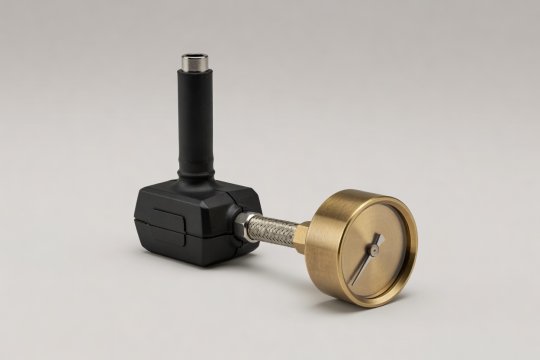
Use a personal dial or digital gauge calibrated to BS EN 12645 before setting off in the morning. If you must drive to a forecourt air line more than two miles away, add 0.2 bar (3 PSI) to the placard target to compensate for warm air expansion, then re-verify cold the next day.
Match Wheel Size & Load
Vehicle placards list multiple wheel diameters (e.g., 16", 17", 18") and two load columns: normal occupancy (1–3 passengers) and full load (5 passengers + luggage or towing). Select the exact row matching the tyres actually mounted on your rims.
Check the Spare or Repair Kit
If your boot houses a space-saver spare wheel, check its high-pressure requirement (often 4.2 bar / 60 PSI). If your car uses a liquid sealant bottle and 12V compressor, inspect the sealant expiry date printed on the canister label.
Inspect Valve Caps & Reset
Always refit plastic or anodized aluminium dust caps equipped with rubber sealing washers to keep winter road salt out of the Schrader valve core. Use only manufacturer-approved caps on metal TPMS stems to avoid galvanic corrosion seizing the cap.
Direct vs Indirect TPMS: What Drivers Need to Know
Indirect TPMS (ABS Wheel Speed)
Indirect systems do not measure air pressure directly. Instead, they use the anti-lock braking system (ABS) wheel speed sensors to compare rotational speed across all four wheels. Because a deflated tyre has a slightly smaller rolling radius, it spins faster than the other three.
Limitation: If all four tyres lose pressure equally over a cold winter month, they all spin at the same relative speed and an indirect system may not trigger a warning. Furthermore, you must manually press the "Set / Calibrate" button in the infotainment menu every time you adjust pressures or rotate wheels.
Direct TPMS (Internal Pressure Transmitters)
Direct systems mount a battery-powered pressure and temperature transducer inside each wheel rim behind the valve stem, transmitting real-time readings to the instrument cluster.
Workshop Care: Sensor batteries typically last 5 to 8 years. Whenever new tyres are fitted, ask the workshop to service the TPMS valve kit (replacing the rubber grommet, washer, nut, and nickel-plated valve core) so slow rim leaks do not develop around the stem hole.