Workshop Inspection Log • Compound Selection • Sidewall Markings • 3PMSF Standards Verify speed and load indices against your V5C and door placard
Compound & Carcass Comparison

Match Rubber to Conditions

Every tyre compound is a chemical compromise between dry rigidity, wet micro-grip, cold-weather elasticity, and rolling resistance. Start by assessing the lowest and highest road temperatures you encounter on your regular routes.

Why the 7°C Glass Transition Rule Matters

Drivers often think of winter tyres as snow equipment, yet their primary advantage lies in polymer chemistry on cold, bare tarmac. Every rubber compound has a glass transition zone—the temperature threshold where elastic polymers begin to stiffen and lose their ability to conform to the tiny peaks and valleys of asphalt aggregate.

Standard summer compounds are vulcanized to stay stable when surface temperatures climb above 30°C or 40°C in July traffic. Once ambient temperatures drop consistently below 7°C (45°F), a summer tread block hardens. On a damp, 2°C November morning, a hardened summer tyre slides across the top of the stone chippings rather(than) keying into them, extending braking distances even when no ice is present.

Conversely, running a soft, high-natural-rubber winter tyre through a warm 22°C spring week causes excessive block squirm. Steering feels vague, stopping distances on dry warm tarmac lengthen, and the soft tread wears rapidly.

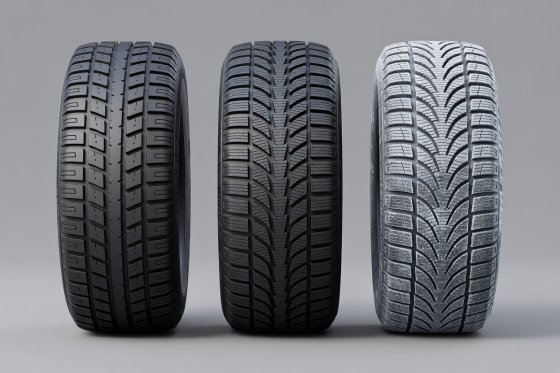
Soft-lit 3D render comparing summer, all-season, and winter tyre tread block geometry and siping

Sidewall Symbols to Verify

  • M+S (Mud & Snow)Geometric groove label only; no mandatory winter test
  • 3PMSF (Alpine Symbol)Three-Peak Mountain Snowflake; UNECE Reg 117 tested
  • XL / Extraload / ReinforcedStrengthened casing for higher inflation & axle weight
  • RFT / SSR / ZP / ROFSelf-supporting run-flat sidewall insert

Condition-by-Condition Tyre Comparison

Use this workshop matrix to weigh how each tyre construction behaves across real-world driving variables.

Performance Factor Summer Touring / UHP All-Season (3PMSF) Dedicated Winter (Alpine) Run-Flat (RFT)
Dry Braking (>15°C) Benchmark shortest stopping distance; high block stiffness Slightly longer stopping distance due to siped block flex Noticeably longer; soft blocks squirm under heavy braking Comparable to standard equivalent compound
Wet Grip (10°C–20°C) Excellent water evacuation via wide circumferential channels Very high; directional V-grooves disperse standing water well Good in cold rain, less stable in warm standing water Matches tread design; stiffer transition over wet joints
Cold Wet & Frost (<5°C) Compound hardens; sudden loss of lateral and braking traction Silica blend stays supple; reliable traction on frosty tarmac Maximum grip; dense sipes bite into frost and rime Depends strictly on whether summer or winter compound
Packed Snow & Slush Unsuitable; grooves pack solid and spin without traction Capable on moderate gradients and urban snow clearance Engineered to trap snow-on-snow shear and climb steep hills Available in winter 3PMSF variants for cold climates
Ride Comfort & Noise Quiet, progressive damping over sharp expansion joints Slight hum from V-pattern blocks on coarse motorway surfaces Softer sidewall feel, higher pitch siping noise at speed Firm ride; reinforced sidewalls transmit road harshness
Sidewall Decoding

Reading 225/45 R17 94W XL

Before ordering replacement rubber, read the exact string moulded into your current tyres and cross-check it with the vehicle's door-jamb plate:

  • 225Nominal section width in millimetres
  • 45Aspect ratio (sidewall height is 45% of 225 mm)
  • RRadial ply carcass construction
  • 17Rim bead seat diameter in inches
  • 94Load index (94 = 670 kg max per tyre)
  • WSpeed symbol (W = rated up to 168 mph / 270 km/h)
EV & Heavy Estates

Extra Load (XL) & HL Markings

Battery-electric vehicles, plug-in hybrids, and seven-seat MPVs place substantially higher static and dynamic loads on tyre beads and sidewalls. An XL or High Load (HL) tyre uses reinforced internal cord plies and bead apex fillers to withstand higher inflation pressures without carcass fatigue.

Never fit a Standard Load (SL) tyre to a vehicle whose handbook mandates XL ratings, even if the physical dimensions (such as 235/45 R18) match. Under-rated casings overheat during sustained motorway cruising.

Run-Flat Rules

Self-Supporting Sidewalls

Run-flat tyres incorporate crescent-shaped rubber inserts inside the sidewalls that support the vehicle's weight for up to 50 miles at a maximum of 50 mph (80 km/h) following a total pressure loss.

Run-flats must only be fitted to vehicles equipped with a functioning Tyre Pressure Monitoring System (TPMS) and suspension bushes tuned for their higher vertical stiffness. Most manufacturers advise against repairing punctured run-flat tyres because driving on a deflated casing can delaminate the internal support ring out of sight.

Next: Inspect Tread Patterns